Incorrect or Missing Revision Control — The Silent Cause of Quality Failures
Revision control failures occur when the Purchase Order does not explicitly lock the exact drawing, BOM, and specification revision to be used for production. This creates ambiguity between RFQ information, engineering changes, and supplier execution, often resulting in parts that are manufactured correctly to the wrong version. Because these errors are usually discovered late and are hard to dispute, they lead to scrap, rework, and delivery delays. Effective revision control requires the PO to
2026-02-04 04:14:35
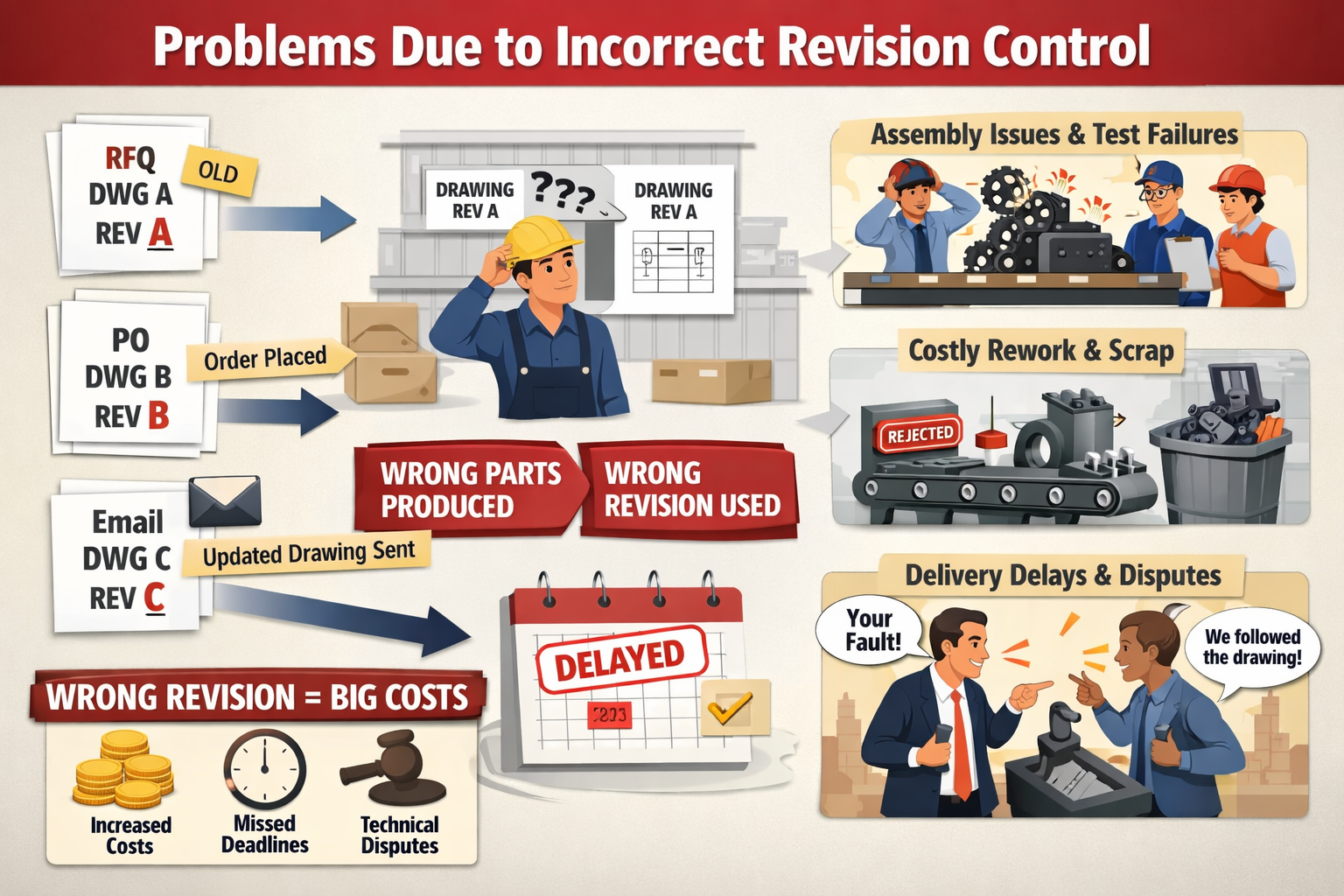
Incorrect or missing revision control is one of the most damaging failure modes in procurement and manufacturing because it silently breaks the link between what engineering intends, what procurement orders, and what the supplier actually produces.
In practice, revision control fails when the PO does not explicitly freeze the exact drawing, BOM, and specification revision that the supplier must follow. Even though suppliers may have received documents during the RFQ stage, those documents are often preliminary and subject to change.
If the PO simply says “as per drawing” or “latest revision applies,” it creates ambiguity: the buyer and supplier may each believe they are working to different versions, and there is no legally enforceable reference point. When this happens, suppliers can manufacture parts that are dimensionally perfect yet completely wrong, because they were made to an obsolete revision.
These errors are particularly costly because they are often discovered late—during assembly, testing, or even in the field—when rework is impossible and root-cause attribution becomes contentious.
Revision control problems are also amplified by informal change communication. Engineering updates sent by email, verbal instructions during calls, or partially updated document sets (for example, a revised drawing without a revised BOM) undermine configuration integrity.
On the supplier side, weak document control can allow obsolete drawings to remain on the shop floor, leading operators to unknowingly manufacture to the wrong version even when the correct revision was originally received.
From a quality perspective, this is especially dangerous because inspection and First Article Inspection may still “pass” if they are performed against the same incorrect revision that was used for production. In such cases, quality systems do not fail visibly; they validate the wrong requirement.
Effective revision control therefore requires the PO to act as a formal reset point that freezes the technical baseline.
A well-controlled PO explicitly states the drawing number, revision, and release date, and clearly declares that it supersedes all RFQ documents and prior communications. Any subsequent change must be implemented only through a formal PO amendment, with the old and new revisions clearly identified and acknowledged by the supplier before production continues.
This discipline ensures that there is always a single source of truth and that every manufactured part can be traced back to a specific, agreed-upon revision. In simple terms, if a revision is not explicitly written, acknowledged, and controlled through the PO, it effectively does not exist—and the risk of scrap, rework, and dispute becomes inevitable.