
First Article Inspection (FAI) and PPAP — Building Defect Prevention into the Process
First Article Inspection (FAI) and the use of Production Part Approval Process (PPAP) are preventive quality mechanisms designed to verify that a supplier’s manufacturing process can consistently produce parts that meet all design, material, and performance requirements before full-scale production begins. When properly implemented, FAI confirms conformance to the approved design baseline, while PPAP demonstrates process capability and control. Together, they shift quality assurance from defect
2026-02-04 04:26:03
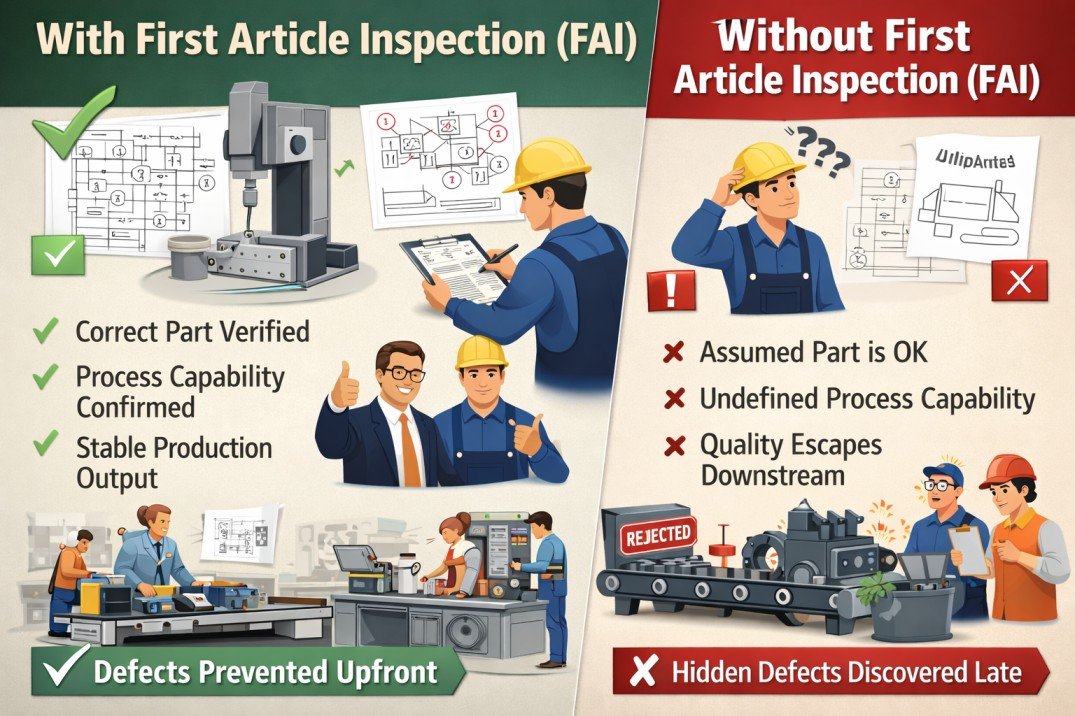
First Article Inspection is critical because it validates that the supplier has correctly interpreted the Purchase Order, drawings, BOM, and specifications and can produce a conforming part under normal production conditions. FAI failures often occur when it is treated as a formality rather than a control gate. If the first article is produced using non-production tooling, hand-selected setups, or additional inspections that will not exist during serial manufacturing, the approval becomes meaningless. A correct FAI requires complete verification of all drawing characteristics against the frozen revision referenced in the PO, supported by objective measurement data, calibrated inspection equipment, and traceable material and process certificates. When this discipline is followed, FAI becomes a factual confirmation that the manufacturing process is capable, not just that a single part happens to be acceptable.
PPAP extends this assurance by requiring suppliers to demonstrate not only product conformance but also process robustness and repeatability. Through elements such as process flow diagrams, PFMEA, control plans, measurement system analysis, and initial process capability studies, PPAP forces potential failure modes to be identified and controlled before defects reach the customer. This is especially important for complex, high-volume, or safety-critical parts, where variation over time is often a greater risk than initial dimensional accuracy. By requiring PPAP submissions and formal approval before ramp-up, buyers ensure that quality is engineered into the process rather than inspected in at the end.
When FAI and PPAP are used together and enforced through the PO, they create a structured quality gate that prevents defects from propagating downstream. FAI confirms that the first part meets requirements, while PPAP proves that the supplier can continue to meet those requirements consistently over production life. Any deviation, process change, tooling modification, or drawing revision then triggers a re-FAI or PPAP update, maintaining alignment between design intent and manufacturing reality. In practical terms, organizations that rigorously apply FAI and PPAP experience fewer escapes, more predictable launches, and far fewer disputes with suppliers, because quality expectations are validated upfront rather than argued after failures occur.